


PLUG or CAP
A plug and a cap are accessories used to close an industrial installation. It is also convenient to use the term "fittings" for all connecting and supplementary elements of an installation - the customary Polish term "armatura" is unclear and ambiguous.
The following refers primarily to threaded metal components in industrial installations.
So what kind of fittings are a plug and a cap: in other words, they are stoppers, elements that close openings, pipe ends. They close them during the operation of the installation and are used primarily for maintenance, inspection, cleaning, etc. during breaks in the operation of the installation.
What is a steel plug?
A plug looks like a type of screw: it has a threaded shank and a head that can be gripped with a tool for screwing it in. The difference results from the application: a screw connects structural elements together, while a plug only closes certain spaces.
The head of a plug can have various, although standardized, shapes: flat hexagonal, square, octagonal, with a square socket, hexagonal socket; a plug may have a rim between the shank and the head called a flange or may not have such a flange ( then theoretically it can be screwed in "infinitely" 😉 ). The connection can be sealed on the thread or with a gasket under the flange.
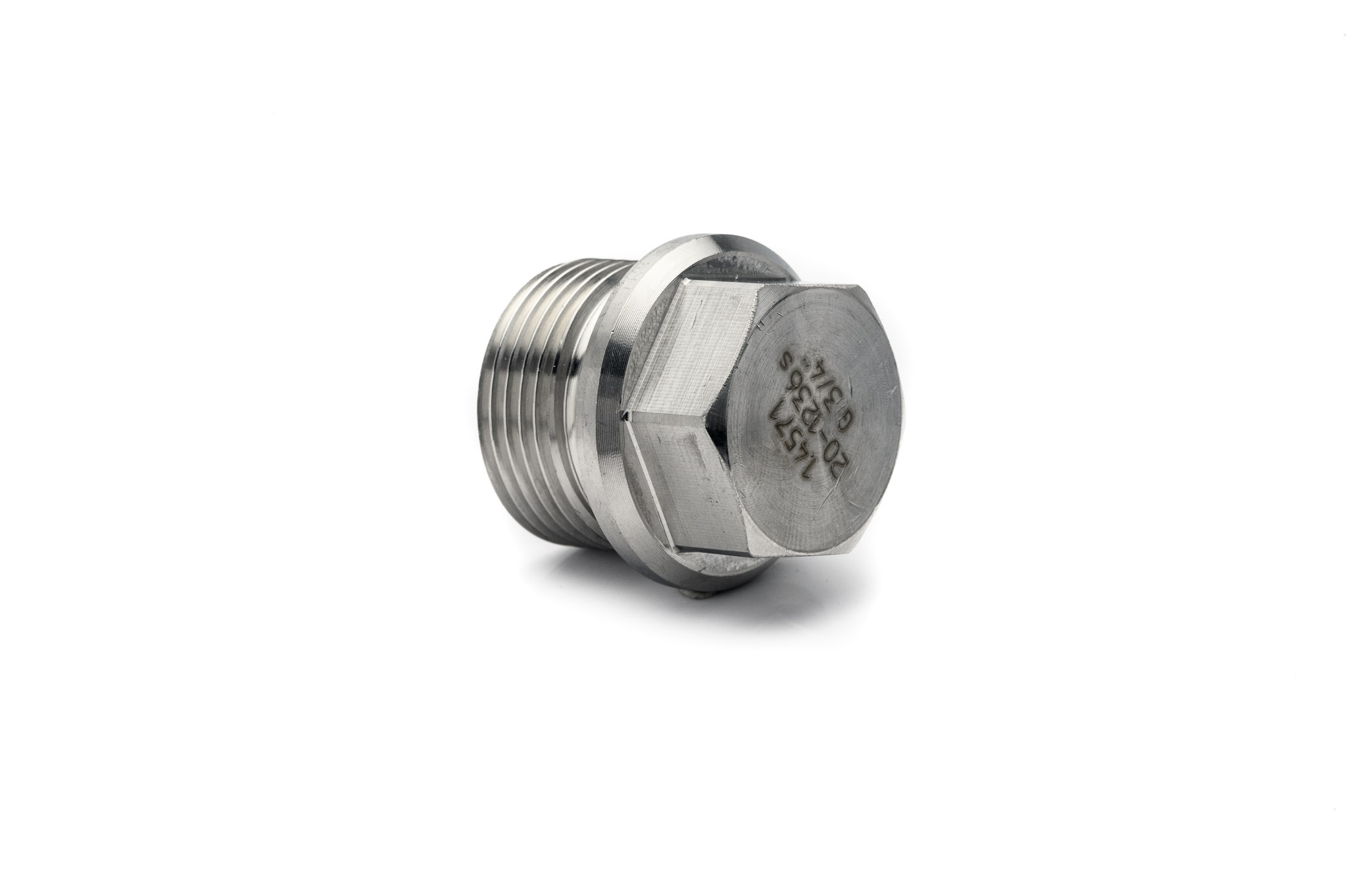

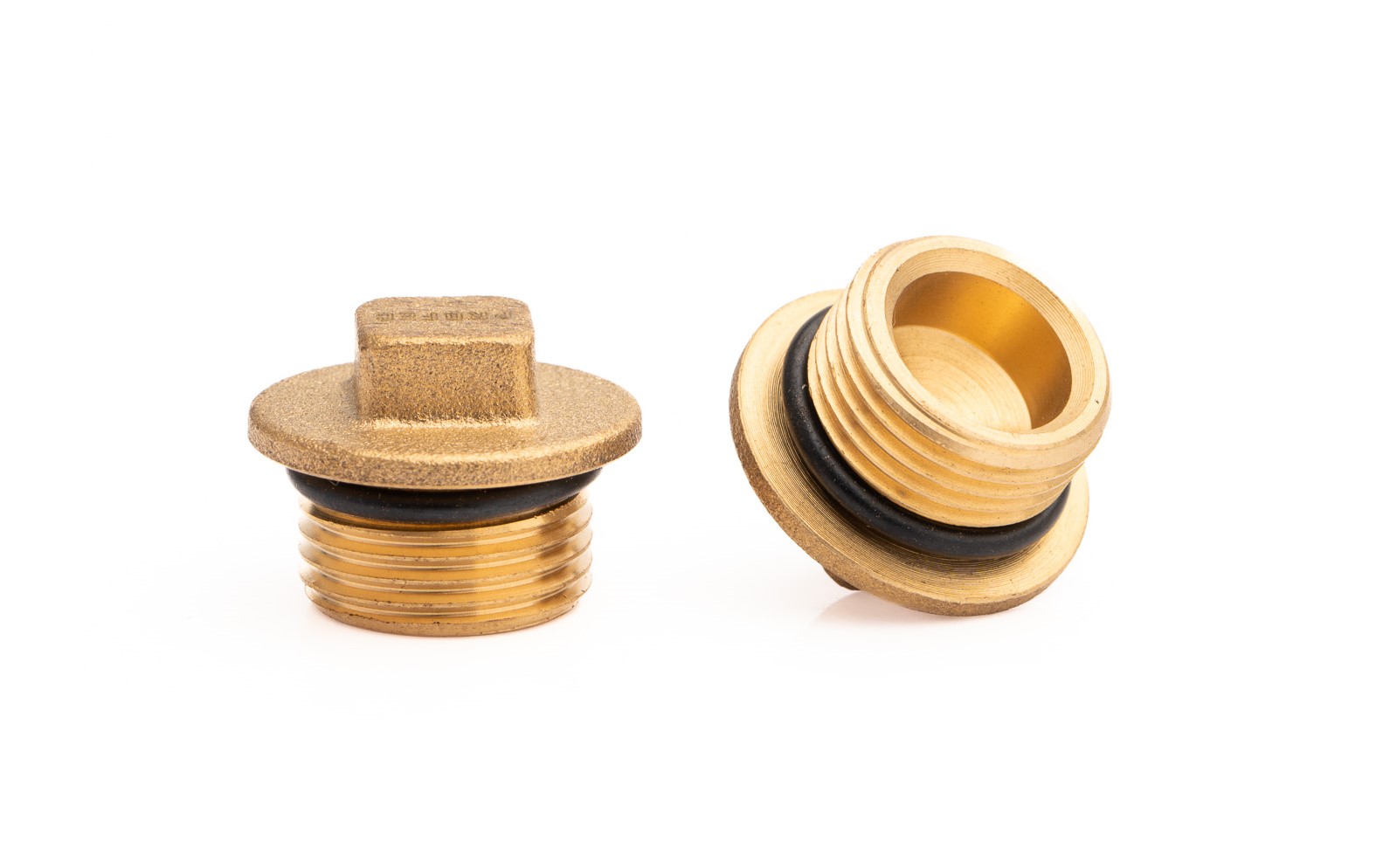
Plug according to DIN 910 Galvanized plug with square head Brass plug
Plugs have threads - of course - external, according to standards such as for couplings, i.e. BSPP (G), BSPT (R), NPT, metric, but additionally there is a thread according to American standards designated UNF: it is a straight (parallel), fine thread, its occurrence obviously results from the globalization of industrial systems; it is by no means unknown, UNF is present, without drawing attention to itself, in the vast majority of drill chucks around the world.
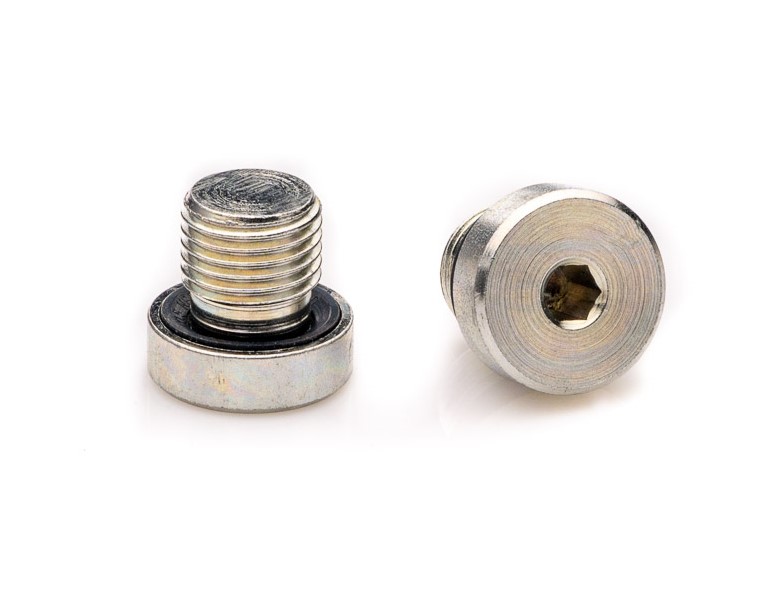

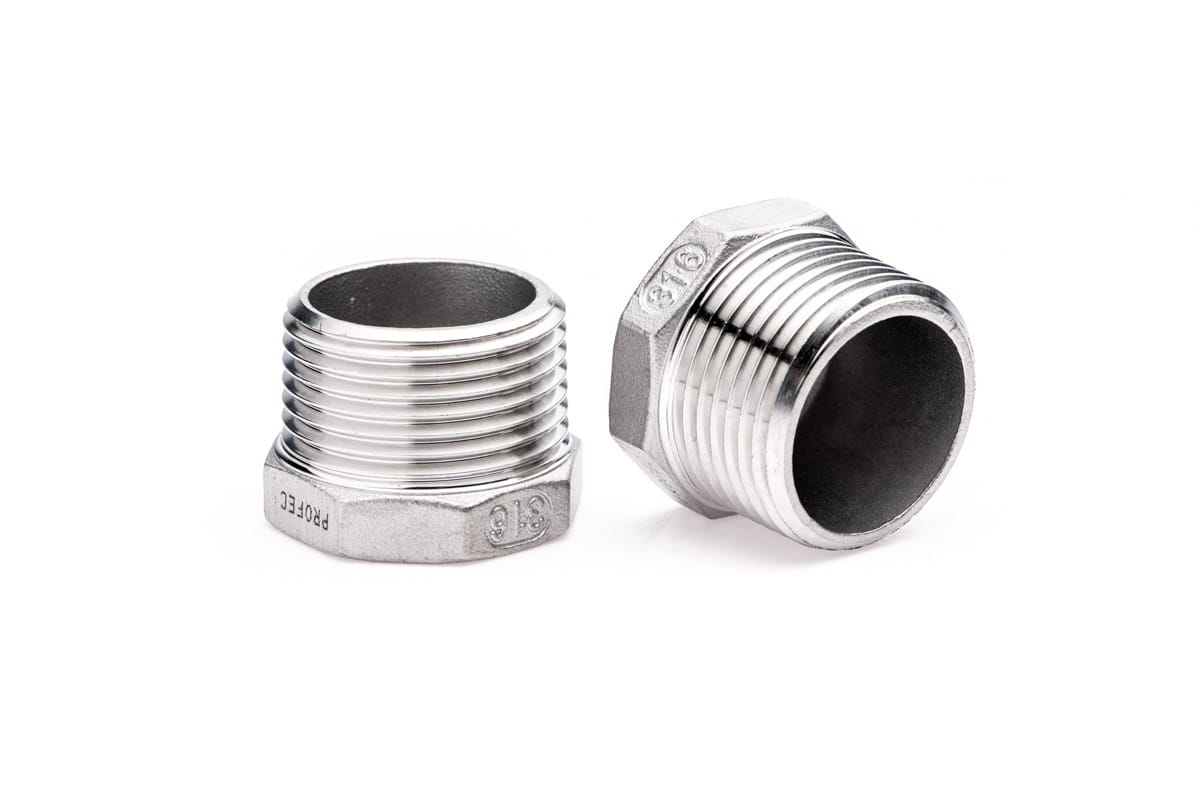
Plug for lower pressure Plug with 60-degree cone 316 stainless steel plug
Plugs according to German DIN standards have become commonly used: DIN 906 with a hexagonal socket without flange, DIN 908 with a hexagonal socket and flange, DIN 909 with a hexagonal head without flange, DIN 910 with a hexagonal head and flange - various types of threads - which set standards for others. There are also quite a few others, for example forged plugs according to the American ASME B16.11 standard; in addition, hydraulic brands (e.g. Parker) create their own standards.
Due to their construction, steel plugs are suitable not only for closing (threaded) pipe outlets but also for openings in bodies, covers of apparatus and equipment, and manifold blocks. Hydraulics is the field in which plugs ( and all kinds of other threaded fittings ) are most widely used, in an environment of high pressures and not very high temperatures. For this reason, materials for plugs should most often have high strength: and such strength is already provided by "ordinary" structural steel, e.g. S235JR, or free-cutting steel - intended for fast machining - e.g. 11SMn30, 36SMnPb14: and their temperature resistance up to 200°C is more than sufficient.
Steel plugs are most often coated with a layer of zinc for protection against corrosion; if necessary, they are made of brass, stainless steel, also aluminium - however, then the cost is significantly higher.
Hydraulics expands its field of application quietly and unspectacularly, it is ubiquitous in our lives, suffice it to say that hydraulic equipment is present in every, literally every, car in the world. And its requirements determine the properties and form of equipment components, hence their diversity and specificity; nevertheless, the characteristic features of a plug are preserved in every type.
Plugs for hydraulics are not always suitable for the power industry, therefore in power equipment, although not those with the highest parameters, as well as in petrochemical and gas installations, plugs made of high-strength materials at elevated temperatures, plugs according to American standards, made of forged A105 steel, find their place. In installations dealing with low temperatures, where e.g. gas expansion occurs, A350 LF2 material is used. Pressure classes are used for these plugs, analogously to couplings, in accordance with specific American rules.


High-pressure BSP A105 plug High-pressure NPT 321 plug
What is a steel cap?
The word CAP has a very, very broad range of meanings.
Many elements even in our immediate surroundings can be called caps, therefore here we will limit ourselves to hydraulic fittings: we will assume that a steel cap is an element with an internal thread, closing the outlets of pipe nipples. Such a cap has the shape of a bowl, dome, cylindrical or hexagonal cap for a pipe.
A steel cap is usually a sealing element, operating under relatively low pressure; cast iron is completely sufficient as a material, in special cases steel or stainless steel. The most suitable thread is cylindrical Rp ( BSP Rp ), depending on the thread of the pipe nipple, another appropriate one.
And here again there is a group of high-pressure caps according to American standards, in pressure classes 2000, 3000, 6000, for - attention - welding in classes 3000, 6000, 9000, made of high-strength materials for operation at elevated temperatures such as A105 or at low temperatures such as A350 LF2, or from other special, non-serially produced materials. With the reservation, precisely this reservation, that these American-standard elements are not entirely correctly called caps, in particular welding fittings would be more appropriately classified as ends ( colloquially due to their size - end caps ). Two types of terminology may conventionally be accepted, depending on the specific application.


High-pressure BSP cap Stainless steel hexagonal NPT cap
A word about caps for hydraulics: the first thing is a blanking nut, with a seal, and the second thing is a fitting for blanking sockets (ports) with a compression cone - such a cap can be supplied with a compression nut. The first and second cap with metric, BSP, UNF, ORFS … thread, compression cone with an angle of 24° or, in the case of the JIS standard, 37°.
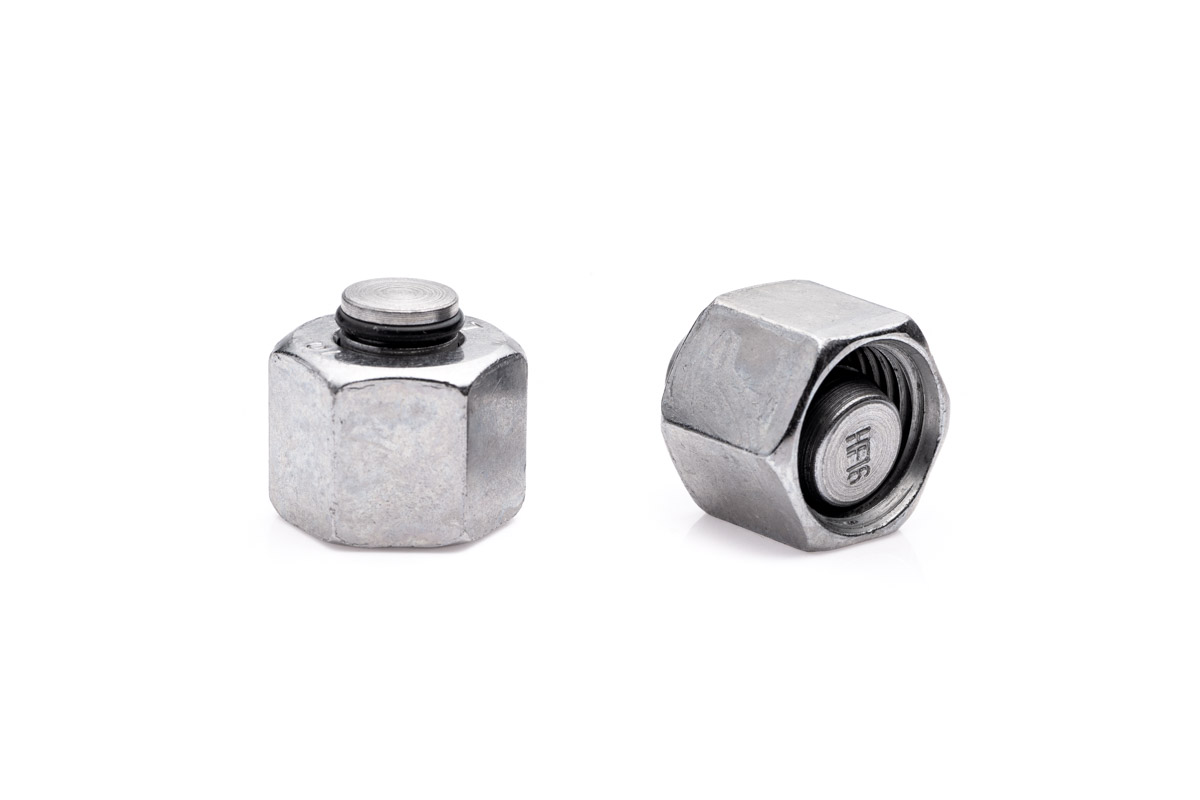
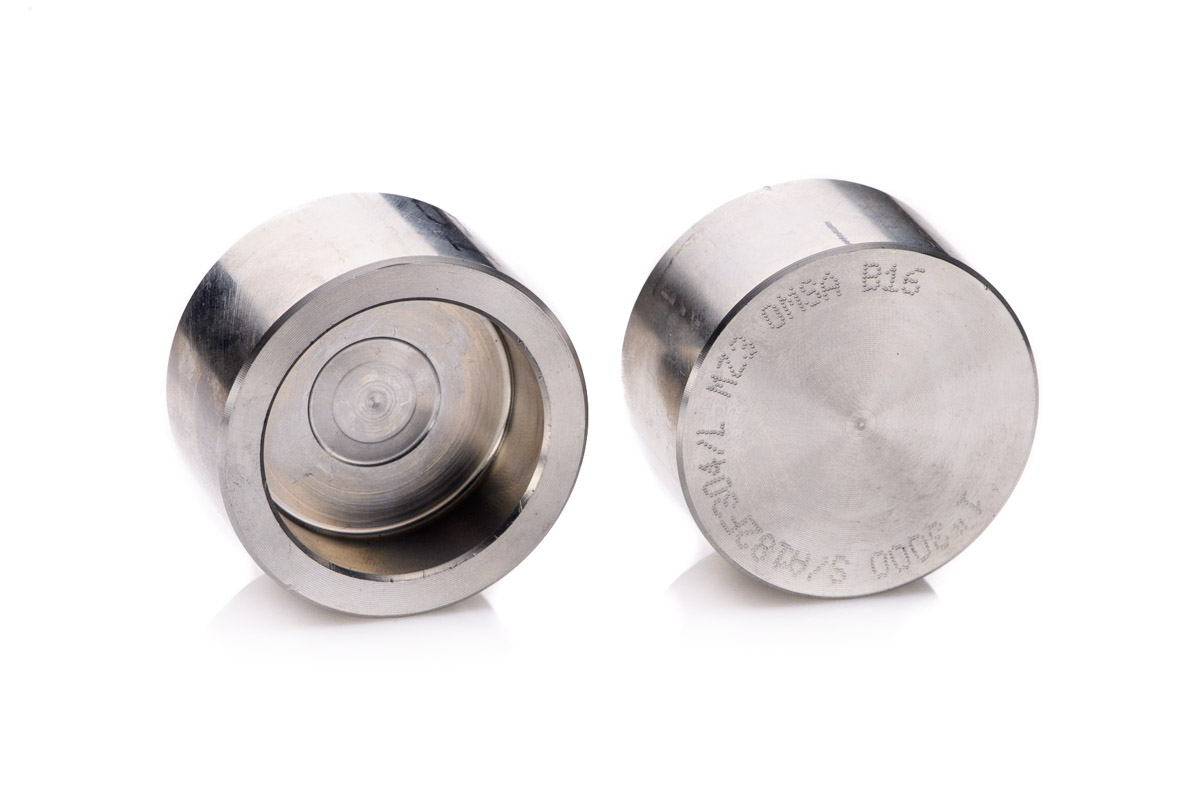
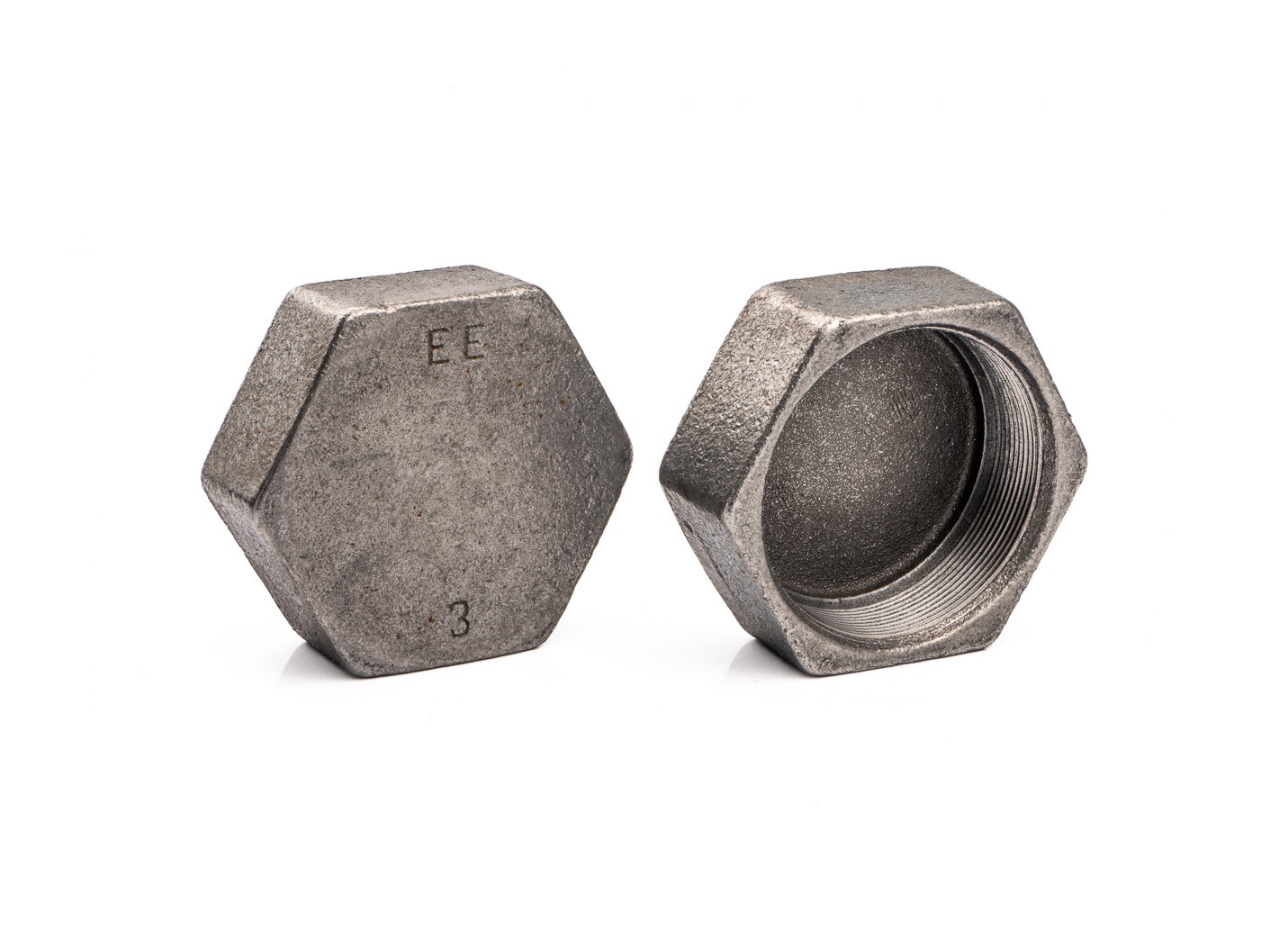
Metric cap Socket weld cap Cast iron cap
Ah, the term cap is sometimes used, perhaps not entirely correctly but in accordance with its function, in reference to a plug.
A plastic cap, due to the infinite number of variants, will not be described in this discussion.
Learn more about Plugs here>>
Learn more about Caps here>>