


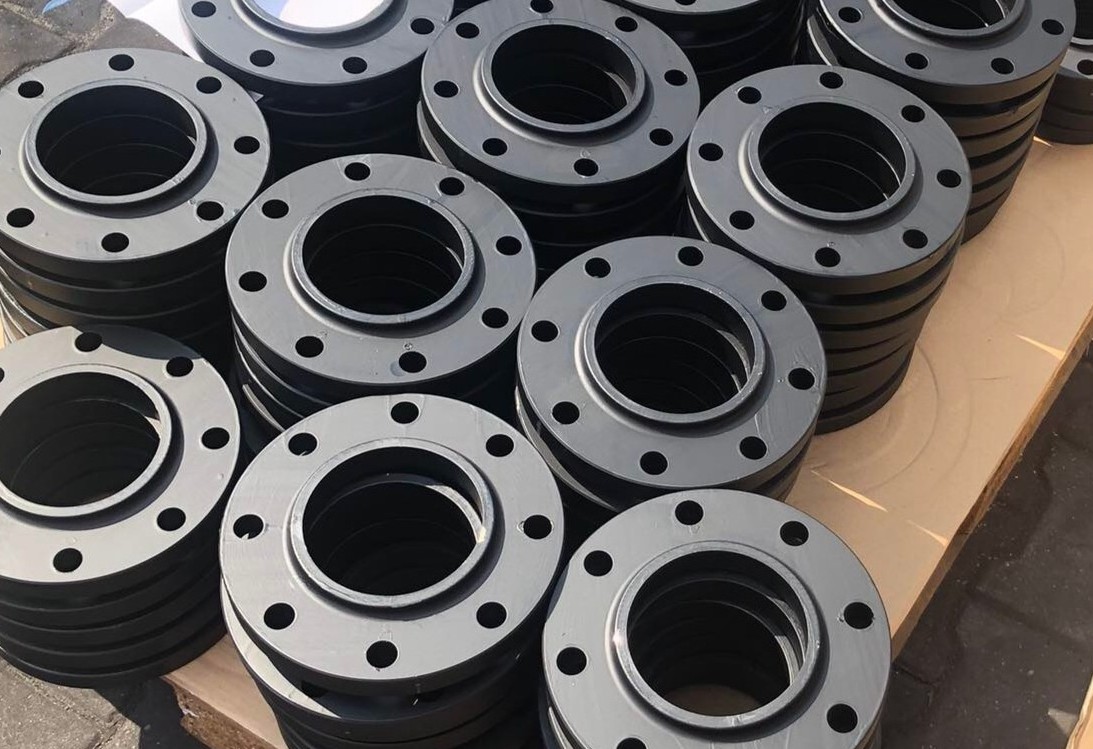
Loose Steel Flange
In this blog, you will learn about its application, material facts and why it is worth buying a loose flange from Polberis.
A loose steel flange is one of the commonly used components for connecting pipes and pipe nipples in industrial, water and sewage installations. Unlike fixed flanges (e.g. weld neck flanges), a loose flange is not permanently welded to the pipe.
How is a loose flange installed?
First, the loose flange is slid onto the pipe, and then a stub end or ring is welded to the pipe, which provides support for the flange and prevents it from slipping off. Two pipe sections prepared in this way are positioned face to face and bolted together, creating a tight and stable connection.
If you are looking for loose steel flanges with certificates, compliant with current standards – check the Polberis shop offer:
[LINK TO LOOSE FLANGES]
Why is the flange "loose"?
A loose flange is not directly welded to the pipe or pipe nipple – it can be freely rotated and only then connected to the other flange. This makes it easier to:
-
align the bolt holes,
-
position flanges in tight spaces,
-
quickly assemble and disassemble the connection (e.g. for inspection, cleaning, replacement of a pipe section). Wherever plant downtime during installation servicing exposes the plant to significant losses associated with downtime.
This solution is ideal for installations that are regularly serviced and wherever quick assembly and disassembly of the installation is important.
Types of loose flanges and typical connections
At Polberis we offer, among others:
-
Loose flanges type 02 according to EN 1092-1
Used in combination with flat welding rings type 32, e.g.: Loose flange DN25 PN10/16 type 02 P250GH 33.7


-
Loose flanges type 04 with a neck ring for welding type 34 according to EN 1092-1: 2013
-
Lap Joint flanges according to ASME B16.5
Used with stub ends, e.g. Flange 4'' Lap Joint B16.5 A105 150lbs

Various diameters and pressure classes are available:
-
according to EN: PN10, PN16, PN40, etc.,
-
according to ANSI/ASME: 150lb, 300lb, 600lb, etc.,
Their purpose is to create a strong, tight ring for connecting two parts of an installation.
Interesting fact – mixing carbon steel and stainless steel
In practice, loose flanges made of carbon steel are very often used in combination with stainless steel pipes and stub ends. Theoretically, such a combination of steel grades is not recommended because adverse electrochemical reactions (galvanic corrosion) may occur between carbon steel and stainless steel.
To prevent this, loose carbon steel flanges are:
-
painted (e.g. with marine paint),
-
powder coated,
-
or galvanized.
We provide all 3 of the above services for our customers. If you need a quotation, write to our specialist Patrycja Kołacka. She will prepare a price proposal for you.
What is the purpose of this?
The protective coating isolates the carbon steel from the environment and reduces corrosion between different steel grades. Thanks to this:
-
the flange is protected against accelerated corrosion,
-
the service life of the connection is extended,
-
the tightness of the installation is maintained for a longer period of time.
So why combine carbon steel with stainless steel at all?
Cost is the key factor. Using 100% stainless steel flanges throughout the entire installation significantly increases its price. Choosing a loose carbon steel flange (with an appropriate coating) together with a stainless steel pipe and stub end makes it possible to:
-
significantly reduce the cost of the entire installation,
-
maintain corrosion resistance in the area in contact with the medium (stainless steel),
-
while using a cheaper flange as a "supporting" element.
This is one of the popular ways to achieve significant savings without compromising the safety and quality of the installation.
Applications of loose flanges
Loose steel flanges are used, among others, in:
-
water and sewage installations,
-
industrial and pressure networks,
-
connections with fittings and valves,
-
installations exposed to erosion and corrosion (loose flanges can be retained and reused, replacing only the pipe nipple or pipe).
Materials, standards and certificates
At Polberis, we offer loose flanges made, among others, from:
-
carbon steel (P235GH, P265GH, A105, A350 LF2),
-
stainless steel (e.g. 1.4301, 1.4404, 3.04L, 316L).
Flanges can also be galvanized or painted, which increases their corrosion resistance and extends the trouble-free operating life of the installation.
Our loose flanges have the required certificates.
Why is it worth buying loose flanges from Polberis?
-
wide selection of diameters and pressure classes
-
availability of painted, powder-coated and galvanized versions,
-
fast shipping and technical advice.
If you are not sure which loose steel flange to choose, how to select the material, pressure class or method of corrosion protection –
contact us.
We will help you select:
-
flange type (type 02, Lap Joint),
-
material (carbon steel, stainless steel),
-
appropriate mating component (ring, stub end, pipe nipple).
We invite you to shop at PolBeris and contact us at tel. 63 2614 202 email: biuro@polberis.pl – we will prepare an offer tailored to your installation and help minimise costs while maintaining high technical parameters.
Feel free to ask about anything, please contact us